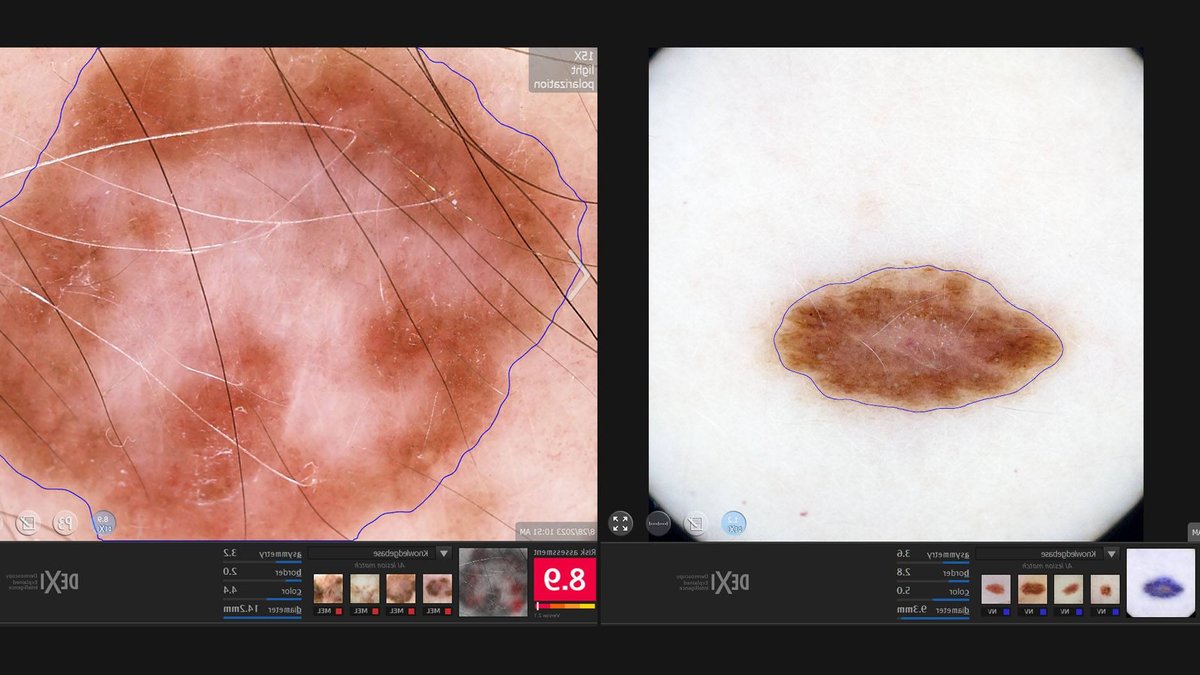
A study in Mayo Clinic Proceedings describes a new AI system called Dermoscopy Explainable Intelligence (DEXI) that helps dermatologists evaluate skin lesions for cancer risk. The tool analyzes images of lesions and assigns them a score from 0.0 to 10.0 based on visual traits associated with malignancy. It also pinpoints specific features, such as asymmetry, border irregularity, and color variations, that contribute to the score, offering doctors supplementary information alongside their clinical assessments.
Testing involved 261 lesions from 178 patients, all previously biopsied and diagnosed. When researchers applied a threshold of 3.0, where scores at or above that level indicated potential cancer, the system detected 93.4% of cancerous lesions while correctly classifying 75% of noncancerous ones. Noncancerous lesions averaged a score of 2.5, whereas nonmelanoma skin cancers scored 7.8 and melanomas 6.0. The distinction between these scores may assist clinicians in deciding whether to recommend biopsies or ongoing monitoring.
The AI was trained on over 66,000 annotated dermoscopy images, a dataset large enough to identify patterns in lesion characteristics. Unlike some opaque AI models, DEXI employs explainable algorithms, providing not just a score but also the visual features that influenced it. This transparency enables dermatologists to cross-reference the tool’s output with their own observations and patient history.
However, the study acknowledges certain limitations. DEXI does not incorporate individual patient factors such as age, medication use, or prior melanoma history. Its accuracy also declined with severely atypical nevi, moles that defy easy classification, and early-stage melanomas, which may lack obvious warning signs. Researchers stressed that the tool should function as an additional resource, not a substitute for clinical judgment.
“Prior to the study, I would review a patient’s DEXI score, but I wouldn’t know exactly what to do with the number,” said Jenny Link, M.D., a Mayo Clinic dermatologist and the study’s lead author. “Now I can confidently use the score as another piece of data to inform my clinical judgment on whether I recommend a biopsy or monitoring.”