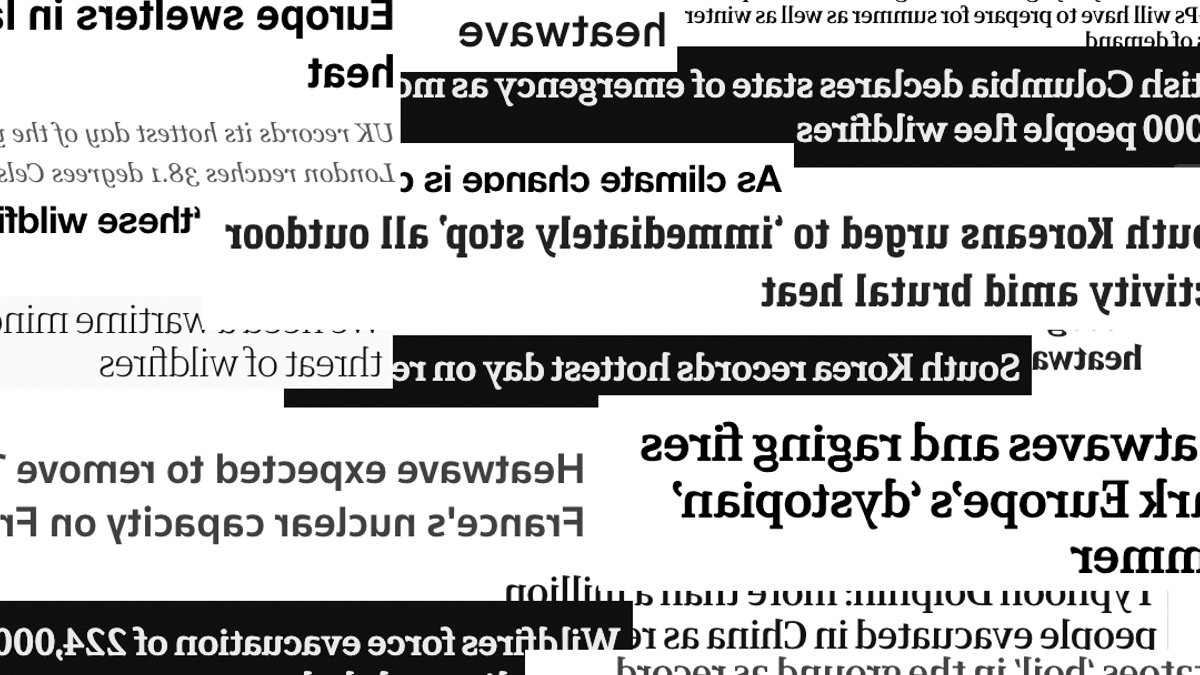
Watching the Northern Hemisphere burn, Australia cannot afford business as usual. From the relative comfort of an Australian winter, researchers have been watching the Northern Hemisphere’s summer unfold through news feeds. Fires, relentless heat, drought, and rivers running low are common themes. These events are not isolated incidents confined to a single town or country, but are unfolding concurrently across Europe and other parts of the Northern Hemisphere.
When you step back from the individual headlines, a more troubling picture emerges. Climate disruption is moving across borders and decimating the systems that sustain us. This is unsettling the foundations of our health, security, and wellbeing. It is difficult to watch without wondering what, if anything, we are learning from this in Australia. The international events do not provide a precise forecast of what Australia will experience this summer, or in the summers that follow. Climate systems do not work that neatly, and Australia’s climate varies enormously across regions. However, the scenes emerging from overseas demonstrate just how quickly heat, drought, and fire can move beyond the environment alone and infiltrate our homes, workplaces, hospitals, food systems and communities.
Preparing for what is coming
Australia is entering a strengthening El Nino. On 28 July 2026, the Bureau of Meteorology reported that El Nino was firmly established and continuing to intensify. Climate models point towards a strong to very strong event, potentially reaching levels among the highest observed since 1950. The Indian Ocean Dipole remained neutral, although models have suggested that a positive event could develop during winter and persist into spring, leading to increased drought and heat in Indonesia and Australia. The Bureau also issued an important caution: a strong El Nino signal in the tropic Pacific does not necessarily mean equally strong effects across Australia. El Nino is one of several interacting influences on our weather, and its effects will not be uniform. But this is not a reason for complacency. Preparedness does not require certainly about which town will break a temperature record, which catchment will receive less (or even more) rain, or where a bushfire may start. It requires us to recognise the direction of risk and act before a seasonal forecast becomes an emergency warning.
Related: Trump’s health policies spark nationwide backlash
The language of climate risk can sound abstract. Terms such as “cascading risk,” “system disruption,” and “adaptation deficit” can obscure what is actually at stake. Climate risk becomes real when an older person living alone cannot cool their home during a heatwave. It becomes real when a pregnant woman must travel a long distance for essential care in extreme heat, or when an outdoor worker must choose between unsafe conditions and losing income. It becomes real when smoke worsens a child’s asthma, when medicines cannot be kept cool during a power failure, and when an exhausted health workforce must respond to several emergencies at once, both in the workplace and in their own lives. Extreme heat increases the risk of heat-related illness and places additional strain on an individual’s cardiovascular, respiratory and renal health. It can adversely affect pregnancy, mental health, occupational safety and the management of chronic disease.
Bushfire smoke can travel far beyond a fire zone, as has happened in North America recently, worsening respiratory and cardiovascular conditions and affecting mental wellbeing. Drought can threaten water security, agricultural livelihoods, rural mental health, and community cohesion. Disruption to food production and supply chains can affect food availability, prices, and nutritional quality. Power interruptions can compromise cooling, communications, medication storage, home medical equipment and continuity of care. Floods, fires and extreme heat can interrupt access to primary care, pharmacies, disability services, aged care, and maternity care at the very time these services are needed the most. This is why the health effects of a severe summer will not be confined to emergency departments counting presentations for heatstroke. They will emerge in homes that become dangerously hot, workplaces where people cannot avoid exposure, communities facing food and water insecurity, and health services trying to operate with disrupted supply, damaged infrastructure and an already stretched workforce. Not every impact can be prevented. But much of the resulting illness, distress and loss is foreseeable and avoidable.
Australia is not starting from ignorance. The first National Climate Risk Assessment in 2025 provided the most full national account yet of how climate change threatens the systems on which Australians depend. It identifies priority risks across health and social support, primary industries and food, infrastructure, communities, supply chains and water security. Its message is unambiguous: climate hazards will worsen under every plausible future. These hazards do not occur in isolation. They interact, compound, and cascade across systems. The National Adaptation Plan provides a framework for responding to these risks. Australia also has a National Health and Climate Strategy, disaster resilience investment and considerable work underway across states, territories, local governments, health services, and community organisations. Australia is not doing nothing. But are we doing enough? Are we acting with the speed needed to truly mitigate avoidable harm?
Related: US to resume Mexican cattle imports in August
We have strategies, assessments and frameworks. The uncomfortable question is whether we have mistaken the production of plans for preparedness. National policy direction does not automatically translate into local capacity. Responsibilities remain dispersed across governments, sectors, and organisations. Plans without dedicated funding, clear accountability, implementation timelines and measurable health outcomes may describe what should happen – without changing what actually does happen. There is also a tendency to treat climate health preparedness as a matter of issuing warnings once danger is imminent. Public messages advise people to stay inside, keep cool, drink water, and check on neighbours. This advice certainly has a place, but it is not an adequate adaptation strategy. People cannot stay cool in thermally unsafe housing without effective insulation, shade or ventilation. They cannot run air conditioning they do not have or cannot afford to use. Some cannot remain indoors because their work requires them to be outside. Others rely on public transport, home medical equipment, refrigerated medicines or carers and services that may themselves be disrupted. Advice directed at individuals can quietly transfer responsibility from governments and systems to households with the least capacity to absorb it.
If Australia is preparing adequately, that preparation should be visible before the first severe heatwave. Governments and health services should be able to explain publicly what they have done in response to the risks identified in the National Climate Risk Assessment. Heat-health plans should include clear activation thresholds, defined responsibilities, and mechanisms for evaluating whether they prevent illness and death. Preparedness must extend beyond hospitals and emergency departments. It needs to include general practice, pharmacies, maternity care, aged care, disability services, mental health services, Aboriginal Community Controlled Health Organisations and community-based organisations. Health services need contingency plans for power and water interruptions, medicine refrigeration, disrupted transport, and supply shortages. Workforce planning must consider the health and safety of clinicians, care workers, emergency personnel and others expected to continue working through extreme conditions. Food and water security must also form part of climate health planning. A health system cannot remain resilient if communities cannot reliably access safe water, affordable food, electricity, transport, or essential medicines.
Governments must prioritise investment in heat-safe housing, energy affordability, accessible cooling and protections for workers exposed to dangerous temperatures. Preparedness also requires locally responsive communication, developed with communities rather than simply distributed to them. Adaptation cannot become another process imposed on communities already carrying the consequences of dispossession and structural inequity. Adaptation can protect people from some of the harms already upon us, but it cannot make continued warming safe.
Related: Premier Urged to Save World-Leading Health Agency
The need for rapid change
Whatever the coming Australian summer brings, the lesson from the Northern Hemisphere is clear: we must prepare for the impacts already arriving while preventing them from becoming more severe. That requires Australia to cut emissions rapidly, accelerate a fair and orderly phase-out of fossil fuels, expand clean energy and decarbonise every sector, including healthcare. Burning coal, oil and gas is not separate from the heat, smoke, drought and food insecurity appearing across our news feeds. It is a central driver of the warming that makes these hazards more frequent and more dangerous. Technical pathways alone will not deliver this transition if policy remains constrained by interests invested in delay. Governments must confront and curtail the influence of fossil fuel industry over policy and politics, placing health, equity and the long-term public interests at the centre of decision-making. A just transition must support workers and communities through economic change, but justice cannot mean postponing action while preventable harms continue to accumulate.
The Northern Hemisphere’s summer cannot tell us precisely what the coming months will bring in Australia. It does, however, tell us something equally as important: climate hazards do not remain within neat policy portfolios, and risk assessments do little when they do not initiate preparation. Heat becomes illness. Drought becomes food and water insecurity. Fire becomes smoke exposure, mass displacement and psychological distress. Infrastructure failure becomes interruption in care. Each disruption places additional pressure on systems already carrying workforce shortages, unequal access and deep social inequities. Australia has already assessed the risks. We have named the threats. We have written plans. The test is whether those plans change what happens before the first severe heat warning, not just in the intention of our plans or how we respond afterwards. The window for action exists now. If we allow that window to close while continuing with business as usual, the harm that follows will not be unforeseen. Much of it will be harm we saw coming, knew how to reduce, and failed to prevent.