
How to Master Health News in 10 Days: A Guide to Medical Literacy
In an era where information travels faster than a heartbeat, staying informed about your health has never been easier—or more confusing. One day, coffee is a miracle elixir for longevity; the next, it is a potential health risk. This constant flux creates a phenomenon known as “headline stress,” leaving many to wonder who they can actually trust. Mastery over health news isn’t about becoming a doctor; it’s about becoming a savvy consumer of information.
If you want to stop being a victim of clickbait and start making informed decisions for your well-being, you need a system. Here is your 10-day roadmap to mastering health news and developing the critical thinking skills necessary to navigate the modern medical landscape.
Day 1: Recognize the Anatomy of Sensationalism
The first step in mastering health news is understanding the “why” behind the headlines. Most digital media outlets operate on an ad-revenue model that prioritizes clicks over nuance. On Day 1, your goal is to identify sensationalist language. Look for words like “miracle,” “cure,” “breakthrough,” or “secret.”
- The Trap: Absolute claims that suggest a single food or pill can solve a complex chronic issue.
- The Reality: Real medical progress is slow, incremental, and rarely happens overnight.
- Action: Compare a headline from a tabloid news site with a headline from a primary source like the New England Journal of Medicine (NEJM). Note the difference in tone.
Day 2: Primary vs. Secondary Sources
To master health news, you must learn to go to the source. A secondary source is a news article or blog post reporting on a study. A primary source is the original peer-reviewed study itself. Today, practice finding the link to the original study in a news article.
If a news story doesn’t link to the original research or name the institution that conducted the study, treat it with extreme skepticism. Legitimate health reporting always leaves a paper trail.
Day 3: Decoding the Headline vs. the Abstract
On Day 3, focus on the “Abstract”—the summary at the beginning of a scientific paper. Headlines often strip away all context. For example, a headline might scream, “Sugar Causes Heart Disease,” while the study abstract clarifies that “high intake of processed fructose is correlated with increased biomarkers in sedentary adults.” These are two very different statements. Reading the abstract helps you understand the specific parameters of the findings.
Day 4: Correlation vs. Causation
This is perhaps the most important concept in health literacy. Correlation means two things happened at the same time; causation means one thing caused the other. For instance, ice cream sales and shark attacks both rise in the summer. They are correlated, but eating ice cream does not cause shark attacks.
- Common Error: Thinking that because people who drink green tea live longer, the tea is the sole reason for their longevity (ignoring that green tea drinkers might also exercise more).
- Action: Ask yourself: “Could there be a third factor involved in this result?”
Day 5: Understanding Study Types and the Hierarchy of Evidence
Not all studies are created equal. On Day 5, learn the “Pyramid of Evidence.” At the bottom, you have animal studies and case reports. While interesting, they don’t necessarily apply to humans. In the middle, you have observational studies. At the top, you have the “Gold Standard”: the Double-Blind, Randomized Controlled Trial (RCT).
If a “breakthrough” news story is based on a study of ten mice, it is far too early to apply that information to your own life. Mastery means waiting for human clinical trials before changing your health habits.
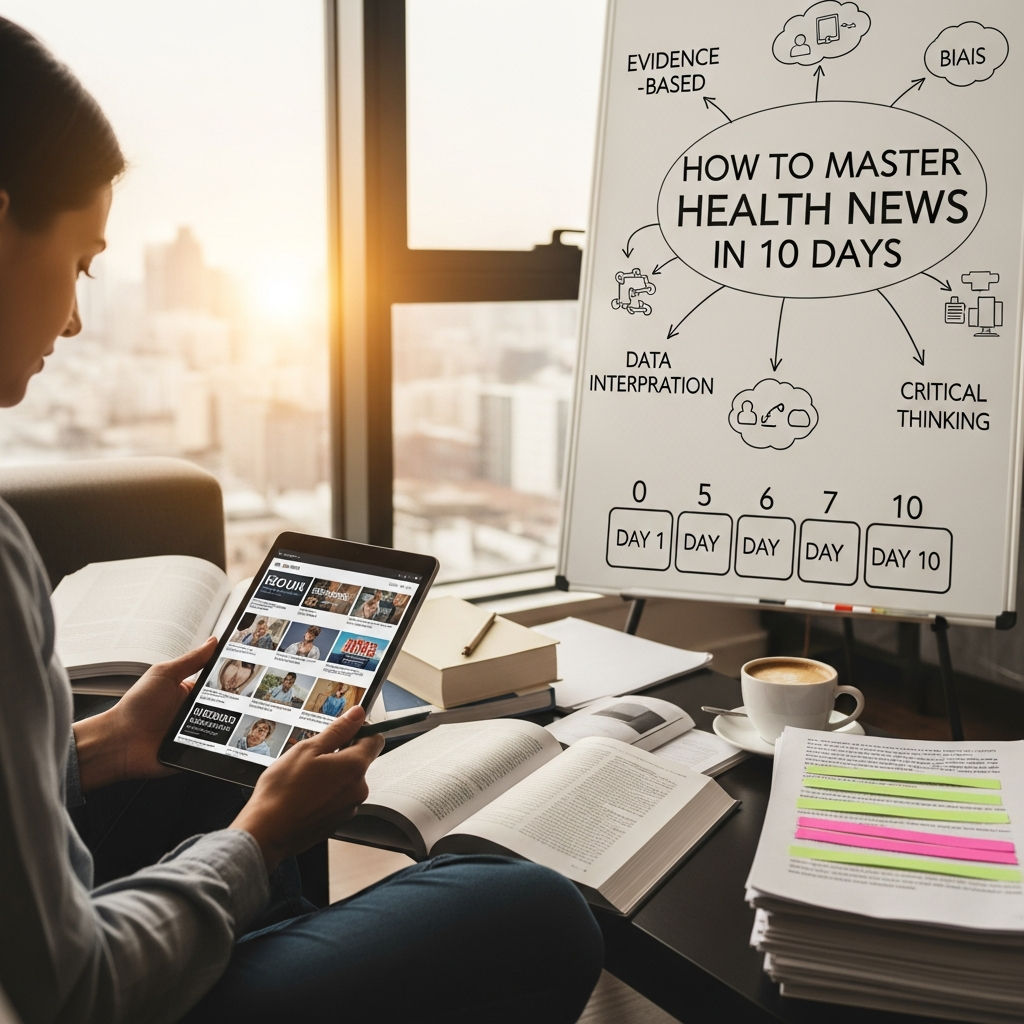
Day 6: Sample Size and Demographics Matter
A study involving 20 people is a “pilot study” and is prone to statistical flukes. A study involving 20,000 people is much more reliable. Furthermore, you must look at who was studied. If a study on heart health was conducted only on men in their 20s, the results might not apply to women in their 50s. On Day 6, look for the “N” number (sample size) and the participant demographics in any health news you read.
Day 7: Follow the Money (Conflicts of Interest)
On Day 7, we look at the “Disclosure” or “Funding” section of research. While corporate funding doesn’t automatically mean a study is “fake,” it is a factor to consider. If a study claiming that chocolate improves cognitive function was funded by a major candy manufacturer, you should look for independent replication of those results. Critical thinkers always ask: “Who paid for this research?”
Day 8: The Power of Scientific Consensus
One study is just a single data point. Mastery of health news requires looking for the “consensus.” Science is a conversation, not a single declaration. On Day 8, search for “Systematic Reviews” or “Meta-analyses” on a topic. These are papers that look at dozens of different studies on the same subject to see what the overall trend is. If ten studies say a supplement works and twenty say it doesn’t, the consensus is that it’s likely ineffective.
Day 9: Social Media Hygiene and “Influencer” Doctors
Social media is the leading source of health misinformation. On Day 9, audit your feed. Be wary of “experts” who sell their own line of supplements or use “fear-mongering” to gain followers. A real health expert will often say “it depends” or “we don’t know yet.” Beware of anyone who has a simple, expensive solution for every health problem.
- Check Credentials: Is the person a board-certified professional in the field they are discussing?
- Check Tone: Are they trying to inform you or scare you?
Day 10: Curate Your Trusted Newsfeed
On your final day, build a “fortress” of reliable sources. Instead of relying on your Facebook feed, bookmark high-quality health news aggregators. By curating your intake, you ensure that the news reaching you has already passed a certain level of scrutiny.
Reliable Sources to Include:
- PubMed: For searching original medical research.
- Cochrane Library: The gold standard for systematic reviews.
- Stat News: Excellent, deep-dive reporting on the biotech and health industry.
- The Mayo Clinic & Cleveland Clinic: For patient-friendly explanations of complex conditions.
- The NIH (National Institutes of Health): For government-vetted health information.
Conclusion: The Empowered Patient
Mastering health news in 10 days isn’t about memorizing medical jargon; it’s about developing a healthy sense of skepticism and a structured method for evaluation. By moving from the headline to the source, checking for funding, and looking for a consensus, you transform from a passive consumer into an empowered patient.
Remember, the goal of health news should be to provide you with tools to discuss with your doctor, not to replace professional medical advice. In a world of “viral” health hacks, your greatest asset is a critical mind. Stay curious, stay skeptical, and keep your health in your own hands.