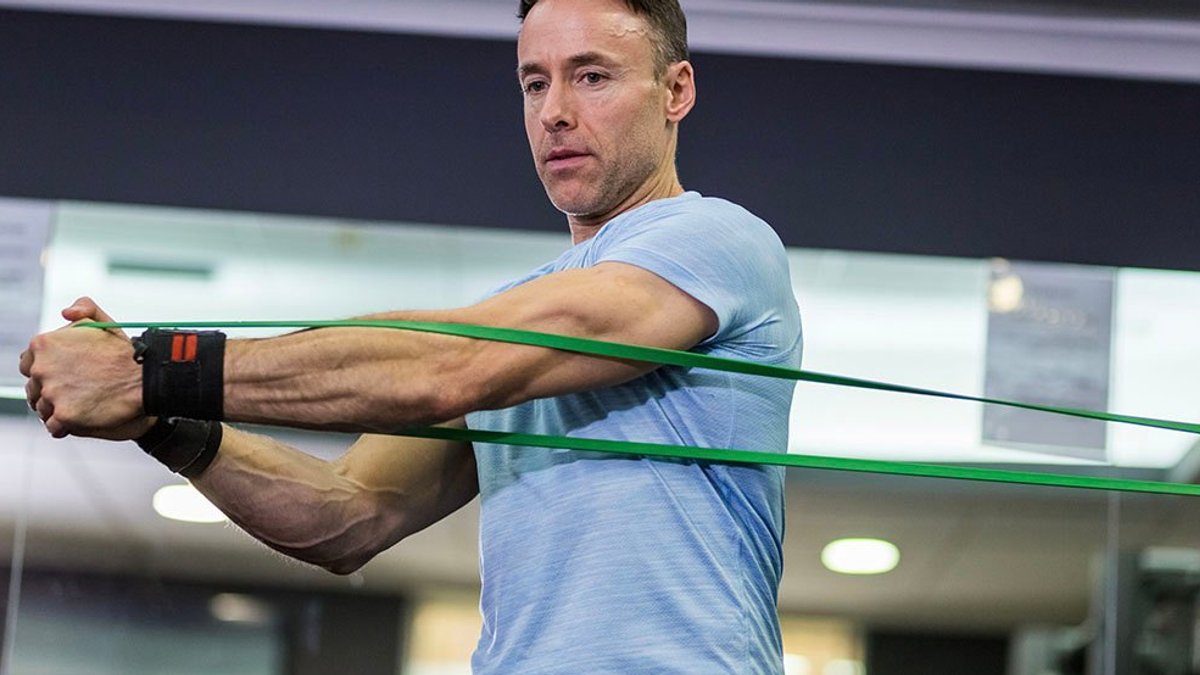
The core plays a vital role in resisting and initiating movement while preventing energy leakage between the upper and lower body. Training all its functions is essential for gains, but it is essential to start by resisting movement.
This exercise challenges individuals to keep their lower body still as their arms move diagonally across their body. The upper back rotates, while the obliques, abs, and hips work overtime to maintain stability.
What is the Cable Wide-Stance Anti-Rotation Chop?
With feet planted in a wide stance, individuals pull a cable across their body while keeping their pelvis and lower torso facing forward. This exercise is different from the standard cable chop, where the hips and torso rotate together.
The result is an exercise that challenges the ability to separate stability from movement, making it an effective way to build a stronger, more stable core.
How to Perform the Cable Wide-Stance Anti-Rotation Chop
To perform the exercise, set the cable pulley just below shoulder height and start with a light to moderate weight. Stand sideways to the cable machine, far enough away to feel tension in the rope attachment. Stand with feet wider than shoulder-width apart, hips, knees, and toes facing forward. Grip the rope attachment as wide as possible, keep arms straight, shoulders down, and brace the core.
Allow the shoulders and upper back to rotate. Slowly return to the starting position, reset, and repeat. The goal is to control what moves and what stays stable, maintaining control as the cable pulls off center.
The exercise also engages the lats, shoulders, and upper back, making it an effective core exercise.
As individuals perform the exercise, they should focus on maintaining control and stability. Keep hips square, feet grounded, and upper back rotating. Arms should follow a diagonal path, and the rib cage should stay down. The return to the starting position should be smooth, with obliques resisting rotation and glutes engaging to resist movement.
Common mistakes to avoid include rotating hips with arms, shifting away from the machine, and twisting the lower back excessively. To fix these mistakes, keep feet planted, reduce the resistance, and focus on maintaining control throughout the movement.
The exercise can be performed as part of a core circuit or as an accessory exercise to strengthen the core.
A sample core and anti-rotation finisher circuit includes the Cable Wide-Stance Anti-Rotation Chop, Dead Bug, and Suitcase Carry. The circuit can be performed with 2-4 sets of 8 to 12 reps per side, depending on experience and strength level. Rest for a minute between sets, and focus on progressive overload and control throughout the exercise.